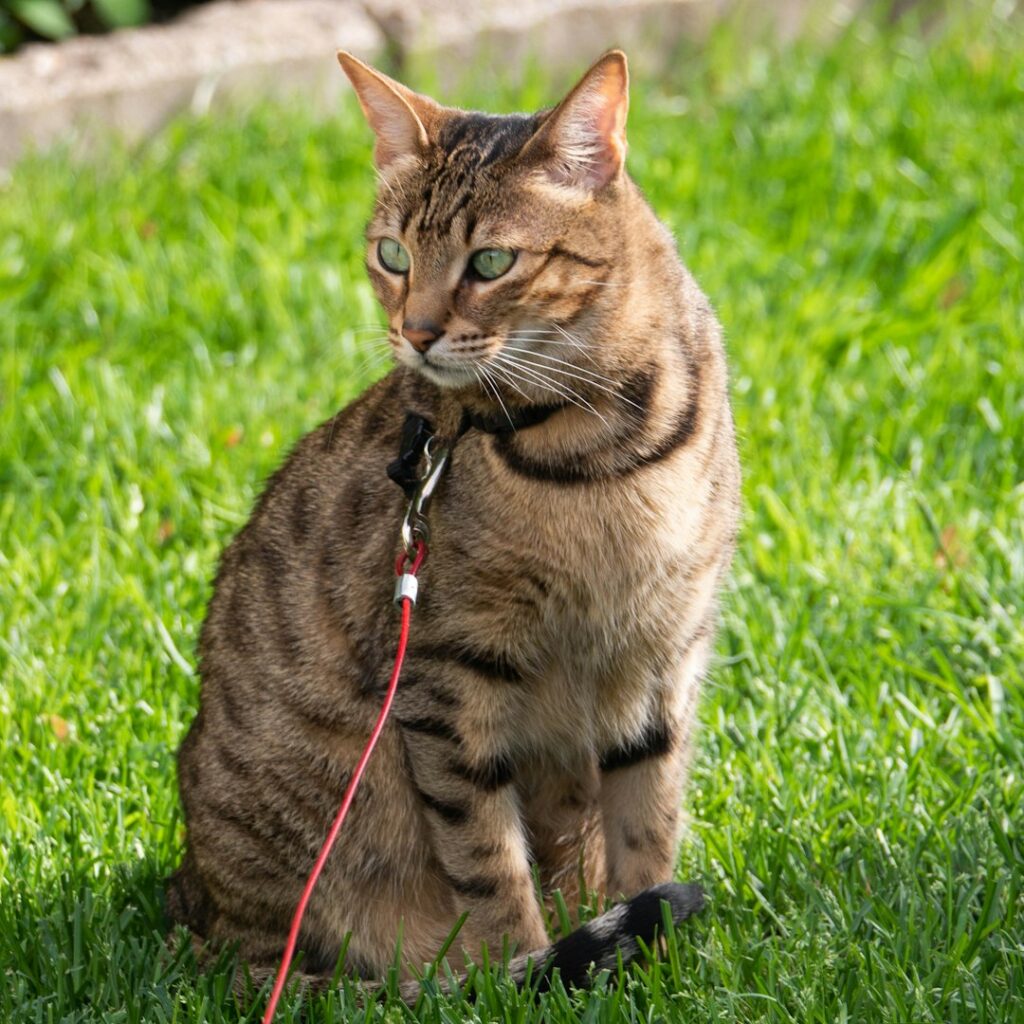
A savannah cat has domestic-cat and African serval ancestry, which makes welfare, provenance, and local restrictions central to any discussion of care. A spotted coat is not enough to establish ancestry or generation, and a sales label cannot guarantee predictable behaviour. Veterinary and welfare organisations raise significant concerns about producing these hybrids, particularly early generations. If an animal already exists in your care, prioritise lawful, competent support for that individual rather than treating unusual appearance as a reason to encourage further breeding.
Savannah cat: understand the hybrid background
The serval is a wild felid, not a domestic-cat breed. Crossing the two creates a different welfare question from crossing two established domestic breeds. A hybrid may have needs and responses that are difficult to accommodate in an ordinary household. Size, activity, fear, handling tolerance, and social behaviour can vary. Do not assume that a dog-like description means the animal will enjoy walks, visitors, or physical affection in the way a seller suggests. Behaviour needs individual assessment rather than a collection of entertaining internet claims.
The Feline Veterinary Medical Association opposes breeding wild felids with domestic cats and discourages ownership of early-generation hybrids because of welfare and behavioural concerns. The RSPCA also opposes the breeding or acquisition of wild-cat hybrids. Those positions should not be hidden behind an attractive breed profile. Caring responsibly for an existing savannah cat and avoiding demand for further hybrid production can be compatible goals. The animal needs appropriate resources and professional support, not punishment for failing to behave like a conventional domestic companion.
Treat generation claims as information to verify
Labels such as F1 or F2 describe ancestry relationships when used accurately, but a number is not a complete behaviour assessment or a guarantee of legal status. Appearance alone cannot verify the claim. Ask for reliable identification and provenance documents, with professional assistance when necessary. Do not accept a photograph of a tall spotted adult as proof of a particular percentage of wild ancestry. A seller’s description may also use terms inconsistently, so unclear claims deserve questions rather than confident interpretation.
A later-generation savannah cat is not automatically equivalent to every other domestic cat in needs, temperament, or local classification. Equally, not every individual will show the same difficulties. The practical assessment includes actual behaviour, medical history, handling, social relationships, and the environment. If documentation is incomplete, tell the veterinary team and relevant authorities honestly. Do not invent an ancestry history to simplify a form or assume a registry certificate settles every question. Reliable records help professionals make appropriate decisions, while false certainty can create serious problems for the animal later.
Check rules with the relevant authorities before moving an animal
Ownership, importation, transport, licensing, and local housing rules can differ by jurisdiction and may distinguish hybrid generations or ancestry. Check current official requirements for the actual location and route rather than relying on a breeder, forum, or article written for another country. Obtain authoritative guidance before paying a deposit, arranging travel, or accepting a rehoming commitment. Do not assume that permission in one place means the animal can be taken across a border or moved into a new local area.
For example, Queensland’s official biosecurity guidance treats Savannah cats as prohibited animals, illustrating why general statements about them being legal pets are unreliable. This is not a worldwide rule or a substitute for advice about your own situation. An existing savannah cat should never be released, hidden, or transferred casually because the owner discovers a restriction. Contact the relevant authority and appropriate welfare professionals for lawful options. The animal’s welfare, public responsibilities, and accurate disclosure need to be considered together rather than managed through an informal sale to an unknown recipient.
Consider whether the household can meet the individual’s needs
A hybrid with high activity, strong responses to movement, or limited handling tolerance may be a poor match for a busy household. Assess who lives there, visiting children, other animals, noise, secure space, and the time and expertise available. A large floor area alone does not establish suitability. The animal also needs predictable care, appropriate opportunities to retreat, and professionals willing and able to assist. Do not assume that an experienced domestic-cat owner automatically has the skills or facilities required for an early-generation hybrid.
If you are already responsible for a savannah cat, seek an individual plan rather than trying to prove the household can cope without help. Our pet behaviour guide provides general context for fear and environmental management, but specialist advice may be necessary. Keep expectations realistic about visitors, handling, and other pets. A successful arrangement is one that meets the animal’s needs safely and lawfully, not one in which constant restraint prevents inconvenient behaviour while stress remains unrecognised.
Make secure housing and escape prevention a priority
Review doors, windows, screens, outdoor access, and the behaviour of everyone entering the home. A standard insect screen or casual garden boundary may not provide adequate containment for a powerful active animal. Seek competent advice about appropriate secure facilities for the individual and local requirements. Allow safe usable space, retreat, and enrichment rather than simply making a small enclosure difficult to escape from. Containment must protect welfare as well as prevent departure, and maintenance needs to remain realistic over time.
A savannah cat should not be allowed to roam because a household finds indoor management difficult. Escape can put the animal, other animals, and wildlife at risk and may create legal consequences. Plan a response with the relevant professionals before an incident, including accurate identification and who should be contacted. Do not encourage strangers to chase or corner a frightened hybrid. If the current facilities cannot meet the animal’s needs, discuss lawful specialist support or rehoming rather than improvising increasingly restrictive barriers without a welfare assessment.
Provide useful activity without coercive stimulation
Offer opportunities appropriate to the individual’s abilities and health, with expert guidance where needed. Physical space, stable climbing routes, hiding, scratching, searching, and manageable interaction may all be relevant. The arrangement should allow the animal to choose distance and disengage. Do not force a high-energy performance for a video or repeatedly use frightening stimuli to make the cat move. Activity is not beneficial merely because it is intense, and exhaustion is not a reliable substitute for emotional comfort.
The existing savannah cat may require more specialised enrichment planning than a general toy list provides. Watch whether the animal can settle afterwards and whether a particular activity increases frustration or repetitive behaviour. Keep strings and small swallowable parts controlled. Our cat string-swallowing guide explains why interactive equipment needs supervision and secure storage. Suitable enrichment should expand normal behavioural choices without introducing ingestion hazards or making the household dependent on continual high-arousal games to keep the animal occupied.
Feed according to a qualified nutritional plan
Wild ancestry does not make an unbalanced raw-meat menu automatically appropriate. Ask a veterinarian with relevant expertise to assess life stage, body condition, health, and the actual diet. A complete appropriate feline food may be part of the plan, while any special nutritional requirements need professional formulation rather than a seller’s generic recipe. Raw products can carry nutritional and infection risks, and adding supplements without understanding the existing diet can create further problems. Do not assume more expensive or more exotic ingredients mean better care.
Our cat nutrition guide explains general balanced-feeding principles, but an individual savannah cat may need additional specialist input. Monitor actual intake, body weight, and stool changes, and keep fresh water accessible. Separate feeding where animals would otherwise compete. Persistent poor appetite, weight loss, vomiting, or unusual thirst deserves assessment rather than a confident attribution to hybrid temperament. A food plan should support physical health and practical monitoring, not become another way of making the animal appear more wild for human interest.
Organise veterinary access before a crisis
Contact an appropriate practice in advance and describe the known ancestry, documentation, health history, and handling concerns. Ask whether the team has the facilities, experience, and legal arrangements needed to provide care. A clinic should not first discover a difficult handling situation when an unwell animal arrives unexpectedly. Discuss transport, carrier suitability, examination approaches, and out-of-hours support. Keep records accessible so another caregiver can communicate accurately if you are unavailable. Avoid withholding provenance because you worry that the information will complicate the appointment.
A savannah cat needs an individual preventive-care plan, including vaccination and parasite discussions appropriate to the animal, locality, and official requirements. Hybrid status can affect clinical and regulatory questions, so do not copy a domestic cat’s paperwork or assume a seller’s vaccine claim answers every issue. Our cat vaccination guide offers general context; the treating veterinarian must determine the applicable plan. Professional preparation is more useful than relying on an emergency service to improvise when transport, containment, and safe examination are all unresolved.
Read stress and discomfort without punitive handling
Hiding, avoidance, changes in appetite, elimination, grooming, or social behaviour can indicate that something is wrong, but they are not a diagnosis by themselves. Observe the pattern and give the animal appropriate space. Do not punish marking, growling, or defensive responses to remove inconvenient signals. Forceful contact can worsen risk and distress. Seek professional assessment that considers medical causes, environment, and behavioural needs together rather than treating the animal’s ancestry as a complete explanation for every difficulty.
Our subtle feline pain guide describes changes that are easy to miss. An existing savannah cat can become ill or painful like any other animal, and a sudden change should not be dismissed as normal wild behaviour. If there is severe distress, collapse, breathing difficulty, inability to pass urine, or another acute concern, contact the appropriate veterinary service urgently. Do not delay because you are uncertain whether the problem is behavioural. Clear disclosure and careful instructions are especially important when handling may be difficult.
Keep children, other pets and visitors out of unsafe situations
Do not rely on an attractive family-pet video to predict the response to a child, dog, or small animal in your home. Introductions need individual planning, and some combinations may be inappropriate. Keep vulnerable animals secure and avoid using them as an enrichment target or socialisation test. Visitors should understand boundaries, including not reaching into hiding places, pursuing the cat, or attempting to pick them up. Adult responsibility cannot be delegated to a child because the animal has previously appeared friendly.
A savannah cat that tolerates one person may respond differently to another person’s movement, smell, or handling. Respect that variation and seek support rather than forcing repeated interactions to make the animal sociable. Provide a suitable private area during necessary visitors or household work, without leaving the animal isolated in inadequate conditions. The practical aim is predictable safety and welfare. A household should not need continual crisis management, threats, or physical restraint to prevent ordinary movement by people and animals from becoming a dangerous event.
Consider responsible support and lawful rehoming
If the current situation is not working, ask the veterinarian, relevant authority, and competent welfare professionals about appropriate options. Be honest about ancestry uncertainty, behaviour, health, and containment needs. Do not advertise the animal as an easy exotic pet to make transfer faster, and do not send them to an unknown recipient without checking lawful suitability. An existing cat deserves a plan that protects their future, not a sequence of informal sales prompted by recurring problems that nobody discloses.
Avoid breeding or purchasing another hybrid as a supposed companion solution. Welfare concerns extend beyond the individual already in your care to the animals used in producing further generations. Enjoying a savannah cat’s personality does not require promoting the creation of more hybrids. A responsible account can acknowledge affection while explaining the practical and ethical difficulties honestly. If you are still deciding what companion to adopt, consider an assessed domestic cat whose needs fit your resources, rather than assuming a wild-looking appearance will make the relationship more rewarding.
Review support before a household move
A change of home can alter official requirements, containment, available veterinary support and the animal’s daily environment. Check those issues before arranging transport, even when the current household has managed comfortably for years. Do not rely on the previous address’s paperwork or assume a landlord’s permission answers every relevant question. Keep identification, medical records and known ancestry documents together so the appropriate professionals can give informed guidance. If the proposed destination cannot lawfully or practically meet the animal’s needs, seek competent advice early rather than arriving first and trying to solve the problem afterwards. Planning in advance gives more opportunity to protect welfare and avoid an unnecessary crisis during an already disruptive transition.
Frequently asked questions about hybrid-cat care
Can appearance prove the generation? No. A spotted coat, long legs, or large ears cannot establish precise ancestry. Reliable provenance and appropriate professional interpretation matter, while behaviour still needs individual assessment.
Does a later generation remove every concern? No. Needs and rules can still vary, and an ancestry label is not a guarantee of predictable temperament or permission in every jurisdiction. Check the actual situation before ownership, travel, or transfer.
Can a secure enclosure solve everything? Containment is one requirement, not a complete welfare plan. The animal also needs suitable usable space, resources, preventive and medical care, behavioural support where needed, and competent people able to provide them.
What should an existing owner do first? Gather accurate records, confirm applicable official requirements, and arrange a veterinarian and appropriate support network. Address immediate welfare and safety needs without hiding the animal’s history, encouraging further breeding, or releasing them because the situation has become difficult.