

Mange in Dogs: Sarcoptic vs. Demodectic, Symptoms & Treatment
“Mange in dogs” isn’t a single disease but a category covering two very different microscopic mite infestations with distinct causes, contagion risk, and treatment approaches. This guide explains the crucial difference between sarcoptic and demodectic mange, how to recognize each, why one is contagious to humans and the other generally isn’t, and what effective treatment looks like for both.

Mange in dogs: Sarcoptic Mange: The Contagious Type
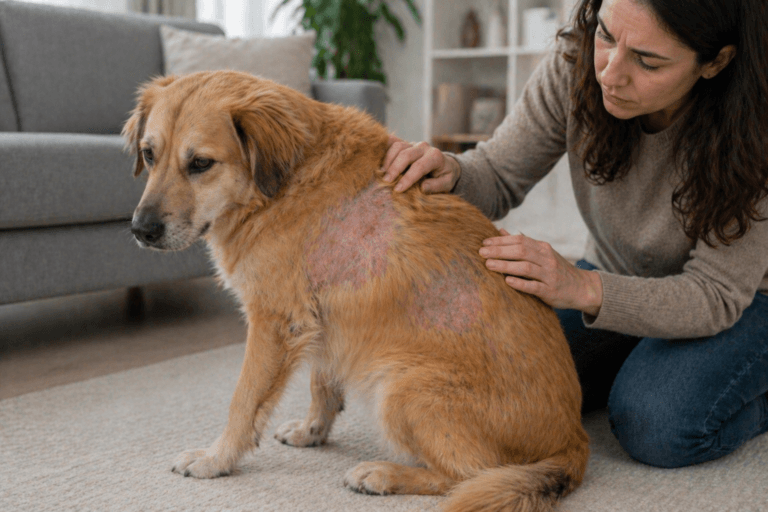
Sarcoptic mange in dogs is caused by a mite that burrows into the skin, triggering an intense allergic-type itch response that’s often the most striking feature owners notice. It spreads through direct contact with an infected animal or a contaminated environment, making it genuinely contagious between dogs, and notably, it can also cause a temporary, itchy rash in humans who handle an infected dog, though the mite cannot complete its life cycle on human skin and human symptoms typically resolve once the dog is treated and contact ends. Commonly affected areas include the ear margins, elbows, belly, and chest, often showing hair loss, crusting, and thickened skin from the intense scratching the itch provokes. Because of how contagious it is, any other pets in the household, and sometimes even the household environment through bedding, should be considered as part of treatment planning.
Demodectic Mange: The Immune-Linked Type
Demodectic mange in dogs is caused by an entirely different mite that actually lives normally in small numbers in most dogs’ hair follicles without causing any problem at all. Disease occurs when the immune system, usually because it’s still immature in a young puppy, or compromised by another illness, stress, or medication in an adult dog, fails to keep the mite population in check, allowing it to multiply and cause skin inflammation. Unlike sarcoptic mange, demodectic mange is generally not considered contagious between dogs or to humans, since it reflects an individual dog’s immune status rather than an easily transmitted organism. It commonly appears as localized patches of hair loss, often around the face and legs in puppies, which frequently resolve on their own as the immune system matures. A more generalized form, affecting larger areas of the body, is more serious and, particularly in an adult dog with no prior history, warrants investigation into what might be suppressing the immune system.
| Feature | Sarcoptic mange | Demodectic mange |
|---|---|---|
| Itchiness | Intense, often severe | Usually mild or absent |
| Contagious | Yes, to other pets and temporarily to humans | Generally no |
| Typical dog | Any dog, any age | Puppies (localized) or immunocompromised adults (generalized) |
| Common areas | Ear margins, elbows, belly, chest | Face and legs (localized); widespread (generalized) |
| Underlying cause | Direct mite exposure/contact | Immature or compromised immune system |
How Mange Is Diagnosed
Diagnosis relies on a skin scraping, a quick, minimally uncomfortable procedure where a veterinarian gently scrapes a small area of affected skin and examines the sample under a microscope to identify the specific mite present. This step is essential because the two types of mange in dogs, while sometimes looking superficially similar, require different treatment approaches and carry very different implications for other pets and household members. In some cases, particularly with sarcoptic mange, mites can be difficult to find on a single scraping despite a strong clinical suspicion based on symptoms and itch pattern, and a veterinarian may proceed with treatment based on the overall clinical picture even without a definitively positive scraping. For generalized demodectic mange in an adult dog, additional bloodwork is often recommended to investigate for an underlying condition suppressing the immune system.
Treatment for Both Types
Modern mange treatment is highly effective for both types, a significant improvement over historical approaches that were often more prolonged and less reliable. Several current parasite-control medications, some of the same broader-spectrum products used for flea and tick prevention, are effective against sarcoptic mites, often resolving infestation within weeks of starting treatment, alongside management of the intense itch and any secondary skin infection from scratching. Demodectic mange treatment similarly relies on effective miticidal medication, with localized puppy cases sometimes resolving with minimal or no treatment as the immune system matures, while generalized cases need a more sustained treatment course along with addressing any underlying immune-suppressing condition identified during workup. Follow-up skin scrapings during treatment help confirm the mite population is actually clearing rather than relying on symptom improvement alone, since visible improvement doesn’t always mean complete clearance.
Caring for a Dog With Mange at Home
Environmental Cleaning During Sarcoptic Mange Treatment
Because sarcoptic mites can survive for a limited time off the host, cleaning the environment plays a genuine supporting role alongside direct medical treatment. Washing all bedding, blankets, and any fabric items the dog regularly contacts in hot water helps eliminate mites that may have transferred there, and this is particularly worth doing at the start of treatment rather than midway through. Vacuuming carpets and furniture the dog frequents adds another layer of environmental control, though mites generally don’t survive long away from a host, so this is a supportive step rather than the primary focus, unlike some other parasites with longer environmental persistence. Items that can’t be easily washed, certain toys or bedding, can often be set aside unused for a period rather than requiring special treatment, since the mites will not survive indefinitely without a host. This environmental attention matters most in multi-pet households or homes where reinfection risk is a real concern, and your veterinarian can advise on how much environmental cleaning is genuinely necessary for your specific situation versus optional extra precaution.
Why Adult-Onset Generalized Demodectic Mange Warrants Extra Investigation
Because the demodex mite exists normally on healthy dogs in small numbers, its overgrowth into visible disease in a previously healthy adult dog is a meaningful clinical clue rather than simple bad luck. Veterinarians treating adult-onset generalized demodectic mange typically look beyond the skin itself, screening for conditions that could be suppressing immune function: hormonal disorders like Cushing’s disease or hypothyroidism, certain cancers, or immunosuppressive medications the dog may be taking for an unrelated condition. This is one of the more important reasons not to treat adult-onset generalized mange as “just a skin problem” without this broader workup, since successfully treating the mite overgrowth without addressing an underlying cause often leads to recurrence once mite treatment stops. For older dogs in particular, this connection between skin health and broader systemic health is a useful reminder that skin changes can be an early external signal of an internal problem, worth taking seriously rather than dismissing as purely cosmetic.
Mange vs. Common Skin Allergies
Itchy skin has many possible causes, and distinguishing mange from ordinary skin allergies matters for choosing the right treatment path. Environmental and food allergies typically cause a more generalized, seasonal, or diet-linked itch pattern, often affecting the paws, face, and ears without the specific mite-driven distribution seen in sarcoptic mange. Allergic skin disease also doesn’t show mites on a skin scraping, which is ultimately the deciding factor when the clinical picture is ambiguous. Because allergies are far more common overall than mange in many dog populations, a veterinarian evaluating itchy skin typically considers both possibilities, sometimes performing a scraping specifically to rule mange in or out before committing to a longer-term allergy management plan, since treating for the wrong underlying cause wastes time and doesn’t resolve the actual problem.
What to Expect at the Vet Visit
Knowing what a mange evaluation actually involves can make the visit feel less uncertain. Your veterinarian will typically ask about onset, itch level, and whether other pets or household members have developed similar skin issues, since this history helps narrow down which type is more likely even before the scraping. The scraping itself is quick and generally well-tolerated, though a dog with already irritated skin may find it briefly uncomfortable. Results are often available the same visit, since the sample is examined right there under the clinic’s own microscope rather than sent to an outside lab, meaning you typically leave with a working diagnosis and treatment plan started the same day rather than waiting on results.
Frequently Asked Questions
Can humans catch mange from a dog?
Sarcoptic mange can cause a temporary, itchy rash in humans through direct contact, though the mite cannot complete its life cycle on human skin and symptoms typically resolve once the dog is treated. Demodectic mange is generally not a human health concern.
Is demodectic mange always a sign of a serious problem?
Not necessarily. Localized cases in puppies are common and often resolve as the immune system matures. Generalized cases in adult dogs, however, do warrant investigation into a possible underlying immune-suppressing condition.
How long does mange treatment take?
Sarcoptic mange often responds within a few weeks of appropriate treatment, while demodectic mange, particularly generalized cases, may require a longer course, sometimes several months, with follow-up scrapings confirming full clearance.
Can other pets in the house get sarcoptic mange?
Yes, sarcoptic mange is contagious between dogs through direct contact, so other pets in the household should be evaluated and often treated preventively during an active case.
By Dr. Zahid Afzal, DVM — General Veterinary Hospital, Lahore. This article is for general education and does not replace a full physical examination, skin scraping or personalized treatment plan from your own veterinarian.






3 Comments