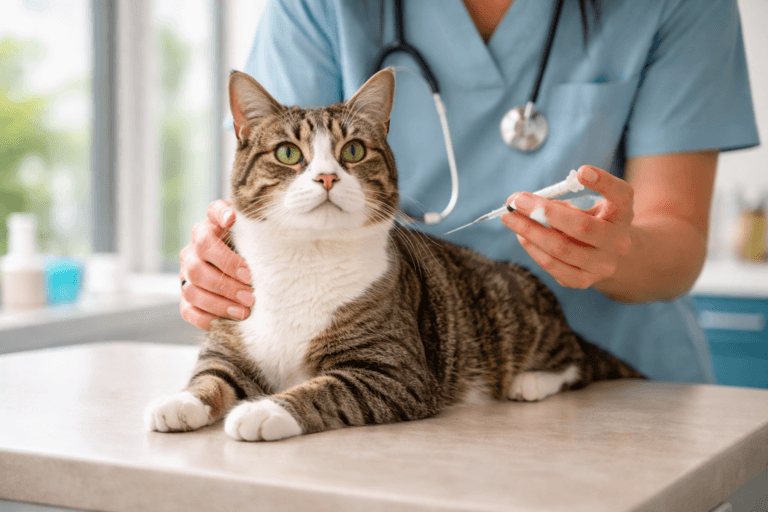
Core vaccines are the ones every dog or cat needs, regardless of lifestyle — they protect against diseases that are widespread, severe, and easily transmitted, like parvovirus in dogs or panleukopenia in cats. Non-core vaccines are recommended selectively, based on where you live, whether your pet goes to boarding or daycare, whether they’re indoor-only, and what diseases are actually circulating in your area. Your vet isn’t upselling you when they skip a non-core vaccine, and they’re not being careless when they add one — the list is built around your specific pet’s actual risk, not a one-size-fits-all schedule.
The question I get almost as often as “when is the next shot due” is a quieter one, usually asked while I’m drawing up the syringe: “Does she actually need this one?” It’s a fair question, and it deserves a real answer rather than “because it’s on the schedule.” Owners who understand why a vaccine is recommended make better decisions — they don’t skip something essential to save money, and they don’t pay for six vaccines when two would do.
Our dog vaccination schedule and cat vaccination schedule guides tell you when. This one tells you why — the actual clinical reasoning behind every core and non-core vaccine, so the next time your vet’s recommendation differs from your neighbour’s dog or your last cat, you’ll understand exactly what’s driving that difference.
What you need to know first
- “Core” is not “more important.” It means the disease is common, severe, and every pet is at risk regardless of lifestyle.
- “Non-core” is not “optional fluff.” For the right pet, a non-core vaccine can matter as much as a core one.
- Your pet’s actual list should be personal. A strictly indoor cat and an outdoor farm cat should not leave the clinic with the same vaccines.
- Core vaccine guidelines are set internationally by veterinary bodies like WSAVA, then adapted by your vet to local disease patterns.
- Geography changes the non-core list more than anything else. Leptospirosis risk in Lahore is not the same as leptospirosis risk in a dry inland region.

Core vs non-core vaccines for dogs and cats: What “core” actually means
Not a marketing tier. A specific clinical definition.
Veterinary bodies define a core vaccine by three criteria, all of which have to be true at once: the disease is widespread in the general dog or cat population, it causes severe illness or death when it isn’t prevented, and the vaccine itself has a well-established safety and effectiveness record. Meet all three, and a vaccine becomes core — recommended for every dog or every cat, everywhere, without needing to assess that individual pet’s lifestyle first.
Canine core vaccines
- Canine distemper virus (CDV) — multi-system, frequently fatal, and survivors often have permanent neurological damage
- Canine parvovirus (CPV-2) — the disease responsible for the majority of unvaccinated-puppy deaths I see in practice
- Canine adenovirus (CAV-2) — protects against infectious hepatitis and contributes to kennel cough immunity
- Rabies — always fatal once symptomatic, zoonotic, and legally mandated almost everywhere
Feline core vaccines
- Feline panleukopenia virus (FPV) — the feline equivalent of parvo; devastating in kittens, spreads through a household fast
- Feline herpesvirus-1 (FHV-1) — a major cause of upper respiratory disease and lifelong recurring flare-ups
- Feline calicivirus (FCV) — another leading cause of cat flu, sometimes with painful mouth ulceration
- Rabies — core for cats too, including cats that “never go outside” — more on that below
Notice what’s not influencing this list: your address, your pet’s routine, or whether they’ve ever left the house. Core vaccines are recommended on the assumption that any dog or cat could be exposed — through a torn window screen, an open door, a visit to the vet clinic itself, or simply from a virus that survives for months in soil and gets tracked in on your shoes.
Core vs non-core vaccines for dogs and cats: What “non-core” actually means
Recommended, not required — and the recommendation changes person to person.
A non-core vaccine protects against something real. The “non-core” label isn’t a judgment about how dangerous the disease is — leptospirosis can kill a dog, and it’s still non-core, because not every dog is meaningfully exposed to it. Non-core status simply means the decision has to be made for your pet specifically, weighing where you live, what your pet does, and what’s circulating locally.
Assessed by lifestyle
- Leptospirosis — dogs with access to standing water, farmland, or rodent-heavy areas
- Bordetella (kennel cough) — boarding, daycare, grooming, training classes, dog parks
- Canine parainfluenza — often bundled with core vaccines, relevant for social dogs
- Canine influenza — only where locally present, group-housed dogs
- Lyme disease — only in regions with established Lyme-carrying tick species
Assessed by lifestyle
- Feline leukemia virus (FeLV) — outdoor access, multi-cat households, unknown-status cats nearby
- Chlamydia felis — multi-cat environments, shelters, catteries with active outbreaks
- Bordetella — high-density housing such as shelters or catteries
- Feline immunodeficiency virus (FIV) — outdoor, unneutered, fight-prone cats; increasingly uncommon to vaccinate for
Indoor cats still need FeLV assessed, not automatically skipped
A strictly indoor kitten is often vaccinated for FeLV in the first year, since indoor status isn’t guaranteed for life — a door left open, a move, a new outdoor sibling. Many vets reassess at the first adult booster and drop it if the cat’s indoor-only status is firm and stable. This is a genuine judgment call, not an oversight either way.
How your vet actually decides
This isn’t guesswork, and it isn’t upselling — it follows a real assessment, the same one WSAVA’s Vaccination Guidelines Group recommends veterinarians use worldwide. In practice, it comes down to four questions I ask about every patient:
- Where do you live?Leptospirosis in a monsoon-prone city with a large stray and rodent population is a different risk than leptospirosis in a dry, low-density area. Regional disease prevalence is the single biggest driver of the non-core list.
- What does your pet actually do?A dog that goes to a groomer, a boarding kennel, or a dog park needs Bordetella coverage. A dog that never leaves a private yard has a much lower-priority case for it.
- Who else is around?A cat sharing a household with a FeLV-positive cat, or a dog frequently around unknown-vaccination-status animals, shifts several non-core vaccines toward “recommended.”
- What’s this individual pet’s health status?Immunosuppressed, elderly, or pregnant animals sometimes need the schedule adjusted — occasionally delaying a non-core vaccine rather than skipping it outright.
Core vs non-core vaccines for dogs and cats: “My cat never goes outside — does she really need rabies?”
Yes, and this comes up almost weekly. Rabies stays core for indoor cats for three concrete reasons: bats get into homes more often than owners expect and are a recognised rabies vector in many regions; a cat can slip out through a door, a torn screen, or a moving day, and only needs seconds of exposure; and in most jurisdictions, rabies vaccination is a legal requirement for all owned cats regardless of indoor status, not a lifestyle-dependent recommendation.
There’s a fourth reason that matters just as much: rabies is essentially always fatal once symptoms start, in any species, including humans. No other vaccine on this page carries that stake if the assessment turns out to be wrong.
Core and non-core, side by side
| Vaccine | Species | Status | Who it’s for |
|---|---|---|---|
| Distemper (CDV) | Dogs | Core | Every dog |
| Parvovirus (CPV-2) | Dogs | Core | Every dog |
| Adenovirus (CAV-2) | Dogs | Core | Every dog |
| Panleukopenia (FPV) | Cats | Core | Every cat |
| Herpesvirus-1 (FHV-1) | Cats | Core | Every cat |
| Calicivirus (FCV) | Cats | Core | Every cat |
| Rabies | Dogs & cats | Core | Every pet, indoor included |
| Leptospirosis | Dogs | Non-core | Standing water, rural, rodent exposure |
| Bordetella | Dogs & cats | Non-core | Boarding, daycare, shelters |
| Canine influenza | Dogs | Non-core | Where locally circulating |
| Lyme disease | Dogs | Non-core | Endemic tick regions only |
| FeLV | Cats | Non-core | Outdoor access, multi-cat homes |
| Chlamydia felis | Cats | Non-core | Multi-cat, shelter environments |
Are we over-vaccinating pets?
A genuinely reasonable question, with a genuinely reasonable answer.
This concern is why core/non-core classification exists in the first place, and it’s also why vaccine protocols have shifted over the past two decades. Older schedules re-vaccinated for everything, annually, without much distinction. Current WSAVA-aligned guidance moved deliberately away from that: core vaccines in adult dogs and cats are typically boostered every three years, not every year, because duration-of-immunity studies showed the protection genuinely lasts that long. Non-core vaccines are added only when the risk assessment supports them, and dropped when it no longer does.
Titer testing: the option most owners haven’t heard of
A titer test is a blood test that measures your dog or cat’s existing antibody level against core diseases like distemper and parvo. If the level is protective, a booster can reasonably be deferred rather than given automatically on the three-year mark. It’s not universally available, it costs more upfront than a booster, and it isn’t a substitute for rabies vaccination in most places, since rabies law is generally based on vaccination status, not titer results. But for an owner specifically worried about over-vaccinating an older or sensitive pet, it’s a legitimate, evidence-based option worth asking your vet about.
Never delay a vaccine due before a genuine exposure risk
If your puppy or kitten hasn’t completed their core series and you’re about to board them, move to a new area, or introduce them to an animal of unknown vaccine status, talk to your vet before the exposure, not after. This is the one scenario where “let’s just wait and see” has real teeth — see our guide to early parvovirus signs in puppies for what an unprotected exposure can actually look like.
Puppies, kittens, and why the schedule looks different
Everything above describes the adult picture. Puppies and kittens get a series of core vaccine doses, not one — typically three doses, two to four weeks apart, finishing at 16 weeks of age or later. This isn’t extra caution for its own sake: antibodies inherited from the mother fade unpredictably in the first months of life, and they block the vaccine from working while they’re still present. A series, rather than a single dose, is how we make sure at least one dose lands after that maternal protection has faded enough for the puppy or kitten’s own immune system to respond. Our dog vaccination schedule and cat vaccination schedule guides both cover this timing in full.
Not sure what your own pet actually needs?
Send your pet’s age, lifestyle and location for a specific, personalized recommendation from a licensed veterinarian.
Book an online vet consultationFrequently asked questions
Can I just ask for the core vaccines and skip everything else?
You can, and for some pets that’s exactly the right call. The point of this guide is that it shouldn’t be a blanket policy — a dog that never boards and lives somewhere with low leptospirosis risk may genuinely need only the core list, while a dog with a different routine in the same city may not. Ask your vet to walk through the specific reasoning for your pet rather than opting out of the conversation entirely.
Is a combination vaccine the same as getting several vaccines at once?
Functionally yes — a combination like DHPP (distemper, hepatitis, parvovirus, parainfluenza) delivers protection against several diseases in a single injection rather than several separate ones. It’s not a way of sneaking in extra vaccines; it’s a convenience that reduces the number of injections and clinic visits needed.
Why does my dog need a non-core vaccine my friend’s dog in the same city doesn’t?
Because the assessment is about your specific dog’s routine, not just your postal code. Boarding, dog parks, grooming visits, hiking in tick habitat — these vary between two dogs in the same neighbourhood as much as they vary between cities.
Do titers replace vaccination entirely?
For core diseases in an adult with a complete puppy or kitten series, a strong titer can reasonably defer a booster. It doesn’t apply to rabies in most jurisdictions, since legal vaccination status — not antibody level — is usually what the law requires, and it isn’t typically used in place of the initial puppy or kitten series, since young animals need the timed doses regardless of any single antibody reading.
My rescue dog has no vaccine history. Where do we start?
When history is unknown, the standard, safe approach is to treat the animal as unvaccinated and begin a fresh core series, rather than guess and under-protect. A titer test can sometimes shorten this if it shows existing protection, but starting fresh is the default for good reason.
Are vaccine reactions common?
Mild, short-lived soreness or quietness for a day is common and not a reason for concern. Genuine allergic reactions are uncommon. This guide covers the vaccine categories themselves — for what a normal reaction looks like versus one that needs same-day care, ask your vet directly when you book the appointment.
Read next from the GV Hospital prevention series
References and further reading
- Day MJ, Horzinek MC, Schultz RD, Squires RA. WSAVA Guidelines for the Vaccination of Dogs and Cats. Journal of Small Animal Practice, World Small Animal Veterinary Association Vaccination Guidelines Group.
- WSAVA — Vaccination Guidelines Group
- American Veterinary Medical Association — Pet Vaccinations
- Ford RB, Larson LJ, McClure KD, et al. 2017 AAHA Canine Vaccination Guidelines. Journal of the American Animal Hospital Association.
Medical disclaimer: This article is written for education and does not replace an in-person veterinary examination. Vaccine recommendations depend on individual health status, local disease prevalence, and regulations that vary by region — decisions about what to vaccinate your specific pet against should be made with a licensed veterinarian who knows your pet and your area.