

By Dr. Zahid Afzal, DVM – Veterinarian & Pet Health Writer
Cooking for your dog gives you control over the ingredients, but a meal can look wholesome and still lack essential nutrients. Before choosing a recipe, understand how a balanced homemade diet is formulated and when to involve a veterinary nutritionist.
This guide explains how to assess homemade dog food recipes, prepare small cooked additions safely and recognise when a complete diet needs a veterinary nutritionist. The examples below have not been nutritionally formulated or analysed as complete meals.
- What “vet approved” really means (and what it doesn’t)
- The basic building blocks of a balanced dog diet
- Three simple homemade dog food recipes you can start with
- How much to feed and how to switch from kibble without upset tummies
- Warning signs that your dog’s homemade diet isn’t working
- When you absolutely need a veterinary nutritionist
This article is general education only and can’t replace a personalised diet plan. If your dog has kidney disease, pancreatitis, diabetes, allergies, or is still growing, please talk to your own veterinarian before using any homemade diet.
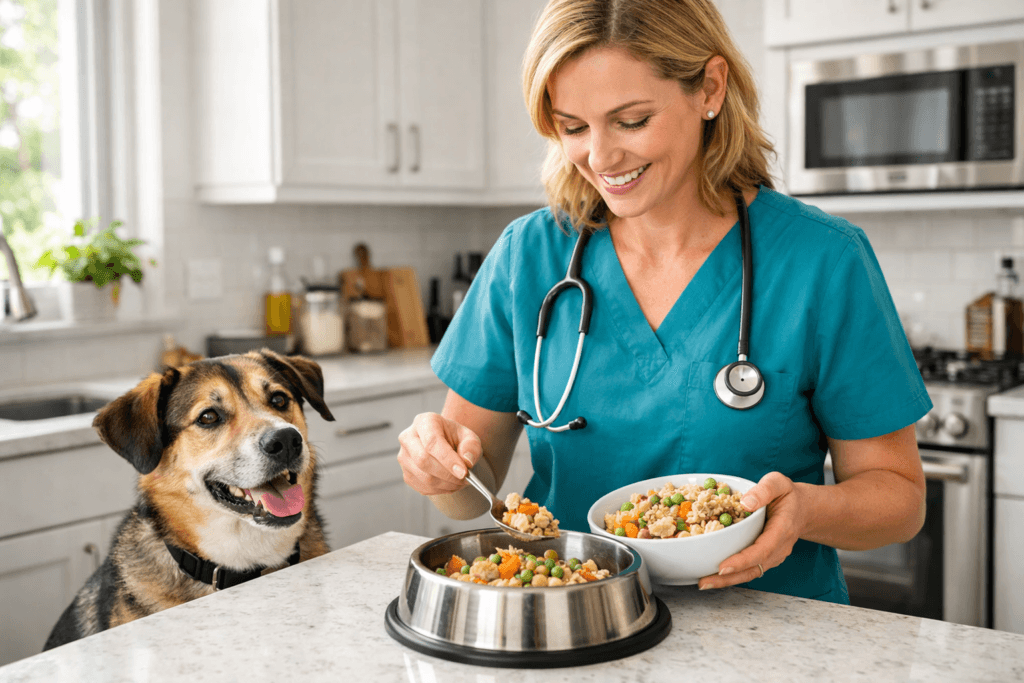
Homemade dog food recipes: What Does “Vet-Approved” Homemade Dog Food Really Mean?
Online you’ll see hundreds of “vet approved homemade dog food recipes.” Sometimes a vet has truly designed or reviewed the diet. Sometimes it just means a vet wrote a sentence at the end saying, “ask your vet.” Those are very different things.
A complete diet must meet the nutritional requirements for the intended life stage. AAFCO and FEDIAF provide nutritional frameworks used in diet formulation and assessment. A complete home-prepared plan needs exact ingredients, gram weights, energy content and any specified supplements; a healthy-looking ingredient list or a veterinarian byline does not establish nutritional adequacy.
So what can “vet approved” honestly mean in a home-cooking context?
- The recipes are designed with basic canine nutrition principles in mind.
- The ingredients are dog-safe (no onions, grapes, chocolate, xylitol, etc.).
- Portion sizes and transition tips are given to reduce stomach upset.
- There is a clear recommendation to involve your own vet for long-term use.
These are cooking examples for discussion with your veterinarian, not complete-and-balanced diet prescriptions. Do not rotate them as full meals or use them to replace a substantial part of a complete diet. For most healthy pets, all treats and unbalanced extras together should remain within a small allowance, generally no more than 10% of daily calories; some medical diets permit less or no extras.
Homemade dog food recipes: Nutrition Basics Before You Start Cooking
Before we jump into recipes, it’s important to understand the main pieces of a healthy dog diet. That way, you won’t get lost in measurements and can evaluate other recipes you find on the internet.
Homemade dog food recipes: 1. Protein: the main building block
Dogs are not strict carnivores, but they do need a good amount of high-quality animal protein for strong muscles, healthy skin, and immune function. Common options include chicken, turkey, beef, lamb, eggs, and fish.
- Good choices: boneless, skinless chicken or turkey, lean beef, cooked eggs, salmon, sardines in water.
- Avoid: cooked bones, very fatty meats, processed deli meats, and anything seasoned with onion or lots of garlic.
2. Carbohydrates & fiber: energy and gut health
Cooked carbohydrates provide energy and can be gentle on the stomach when chosen carefully. They also supply fiber to support the gut microbiome.
- Brown rice, white rice, oats, barley, quinoa
- Sweet potato, pumpkin, and other starchy vegetables
Most healthy dogs can tolerate a moderate amount of carbs, but dogs with diabetes or obesity may need different proportions. That’s another reason to keep your vet involved.
3. Vegetables & fruits: micronutrients and variety
Lightly cooked vegetables add vitamins, minerals, and phytonutrients. They also increase the fibre content of the meal, which can help with stool quality and weight control.
- Dog-friendly veggies: carrots, green beans, peas, spinach, courgette, broccoli florets (in small amounts).
- Safe fruits (small amounts): apple (no seeds), blueberries, banana, watermelon (no seeds or rind). For a practical example, see our vet-approved guide to strawberries for dogs.
Remember there are also toxic plants for dogs. Never include onions, leeks, chives, grapes, raisins, macadamia nuts, or anything with xylitol (a sugar substitute).
4. Fats & oils: concentrated calories
Healthy fats keep the skin and coat shiny, help with vitamin absorption, and provide dense calories. Overdoing fat, however, is a classic trigger for pancreatitis. If your dog has repeated vomiting, abdominal pain, or suddenly stops eating, read our vet guide to vomiting in dogs and why dogs stop eating for warning signs that need veterinary attention.
- Discuss whether an oil or omega-3 product is appropriate before adding it. The dose, calorie contribution and product concentration matter; it is not a substitute for a complete formulation.
- Avoid large quantities of butter, ghee, cream, or leftover frying oil.
5. Vitamins, minerals, and calcium
This is where many homemade diets fall short. The right balance of calcium, phosphorus, zinc, copper, iodine, and vitamins can’t be achieved reliably by “eyeballing” ingredients. For dogs eating homemade food as more than an occasional treat, I strongly recommend:
- Obtain a complete recipe formulated for your dog, including the exact supplement product and amount if required. A generic supplement cannot be assumed to balance an arbitrary mixture of meat, grains and vegetables.
- Or asking a veterinary nutritionist to design a recipe for your dog’s weight and health conditions.
Do not add a supplement by guesswork to the examples below. Supplements differ in formulation and concentration. If a nutritionist supplies a complete recipe, use the exact specified ingredients, preparation method, supplement and amount without substitutions.
Homemade dog food recipes: Three Vet-Style Homemade Dog Food Recipes
The cooking examples are intended only as occasional additions for suitable healthy adult dogs after checking individual tolerance. They are not treatments for vomiting or diarrhoea and are not replacements for a complete food. Keep the rest of the daily ration nutritionally complete and include every extra in the calorie allowance.
- A small occasional topper when your veterinarian confirms it fits the diet.
- A discussion example when asking a veterinary nutritionist about a fully formulated home-prepared plan.
- A preparation demonstration; a dog with digestive illness needs its own feeding and treatment advice.
For dogs with pancreatitis, kidney disease, liver disease, allergies, or other medical conditions, do not use these recipes without individual veterinary advice.
Recipe 1: Gentle Chicken & Rice Comfort Bowl
Plain cooked chicken and rice are sometimes included in clinician-directed short-term feeding plans, but this mixture has not been balanced or prescribed for your dog. Use the example only as a small addition if appropriate. A sick dog needs assessment and an individual feeding plan, not an automatic chicken-and-rice treatment.
Ingredients (makes about 4 cups of food)
- 2 cups cooked white rice (plain, no salt or spices)
- 1 cup cooked skinless chicken breast, finely chopped or shredded
- 1/2 cup cooked carrots, finely chopped
- 1/2 cup cooked green beans, chopped
- 1–2 teaspoons plain sunflower oil or canola oil (optional, for extra calories)
- Do not add an unspecified vitamin/mineral supplement; a complete formulation must name the exact product and quantity.
Instructions
- Boil the chicken in water until fully cooked, then chop or shred into small pieces.
- Cook the white rice according to package instructions, without adding oil or salt.
- Steam or boil the carrots and green beans until soft, then chop.
- Mix the rice, chicken, and vegetables together in a large bowl.
- Add a little oil if your vet has not restricted fat for your dog.
- Allow to cool before serving. Use only within the individual topper allowance discussed below.
Tip: For dogs with sensitive stomachs, do not replace 25–50% of a complete food with this unbalanced mixture. Discuss tolerance and a small topper allowance with your veterinarian.
Recipe 2: Everyday Turkey & Sweet Potato Power Mix
This turkey-and-vegetable mixture is an unformulated cooking example. Its ingredients and appearance do not establish a nutrient profile. It should not be a rotating full meal, a growth diet or a medical diet. Ask about a complete formulation if you want to prepare the main ration at home.
Ingredients (makes about 6 cups of food)
- 500 g (about 1.1 lb) lean ground turkey
- 2 cups cooked sweet potato, mashed (without skin if your dog has a delicate gut)
- 1 cup cooked brown rice or oats
- 1/2 cup chopped spinach (lightly steamed)
- 1/2 cup peas (fresh or frozen, cooked)
- 1 tablespoon salmon oil or fish oil (or as directed by your vet)
- No unspecified supplement is included: this example is not a complete diet.
Instructions
- In a non-stick pan, cook the ground turkey over medium heat until browned. Drain off excess fat.
- Boil or steam the sweet potato until soft, then mash.
- Cook the brown rice or oats according to package directions.
- Lightly steam the spinach and peas.
- Combine the turkey, sweet potato, grains, and vegetables in a large pot.
- Stir in the salmon oil once the mixture has cooled slightly, do not add an unspecified vitamin/mineral supplement.
- Cool completely before portioning into daily meals or freezer containers.
Storage: This mix keeps for 3 days in the fridge or up to 2 months in the freezer in airtight containers. Always thaw in the fridge, not on the counter.
Recipe 3: Protein-Rich Egg & Veggie Breakfast Scramble
This quick recipe is perfect as an occasional high-protein breakfast or as a topper on your dog’s regular food. It’s especially handy for picky eaters.
Ingredients (serves a 15–20 kg / 33–44 lb dog once)
- 2 large eggs
- 1/2 cup low-fat cottage cheese or plain yoghurt (no sugar or xylitol)
- 1/4 cup finely chopped spinach
- 1/4 cup finely grated carrot
- 1 tablespoon cooked rice or oats (optional for added bulk)
- 1 teaspoon olive oil or salmon oil
Instructions
- Whisk the eggs in a bowl.
- Lightly sauté the spinach and carrot in a non-stick pan with a few drops of oil.
- Add the eggs and gently scramble over low heat until just cooked through.
- Remove from the heat, cool slightly, then stir in the cottage cheese or yoghurt and the cooked grains if using.
- Allow to cool to room temperature before serving.
Note: Because this recipe is higher in protein and fat, it may not suit dogs with pancreatitis or kidney disease. Always check with your vet if your dog has any medical conditions.
How Much Homemade Dog Food Is Appropriate?
A universal cups-per-day chart is unsuitable because these mixtures have different, uncalculated calorie densities. Your dog’s energy needs also vary with size, life stage, body condition, activity and health. Do not use the example quantities as a daily ration or increase them until the dog seems full.
For an occasional addition, first ask your veterinarian about a suitable daily calorie allowance. All treats, chews, table food and toppers must share that allowance. For many healthy adult dogs it is no more than 10% of total daily calories, but the individual plan can be stricter. The remaining ration should be complete and appropriate for the dog.
For a complete home-prepared diet, obtain the recipe’s calculated energy and nutrient profile and precise daily gram amounts from a veterinary nutrition professional. Household cups cannot replace those calculations, and body condition checks alone cannot reveal every nutrient deficiency. Follow the exact formulation, including the specified supplement, rather than adding an arbitrary balancing powder.
Monitor body condition and discuss unintended weight changes with your vet. Our senior dog nutrition guide covers related questions. A dog losing weight or refusing food needs investigation, not simply a larger portion.
How to Switch from Kibble to Homemade Dog Food Safely
Switching too fast from commercial food to home-cooked meals is a common reason for diarrhoea and gas. If loose stools develop, use our dog diarrhea guide to recognize when a simple diet upset may need veterinary care. A gentler transition allows the gut microbiome to adapt.
Changing to a complete home-prepared diet
Only transition the main ration after a veterinary nutrition professional has supplied a complete formulation for your dog. Follow the individual transition instructions and continue using the exact recipe. The unbalanced cooking examples on this page are not the destination of a seven-day switch.
If you are adding a small topper to a complete food, introduce it cautiously within the agreed calorie allowance. Do not increase the percentage toward a full meal. Tell your veterinarian about digestive signs, appetite changes or difficulty following the formulation before making substitutions.
Watch for loose stools, vomiting, decreased appetite, or lethargy. If any of these appear, slow down the transition or pause and call your vet. Sometimes a longer transition of 10–14 days is more comfortable for sensitive dogs.
When Homemade Dog Food Is a Bad Idea
As much as I support thoughtful, home-cooked meals, there are situations where homemade food can be risky without a customised recipe.
Dogs that usually need a prescription or custom diet
- Chronic kidney disease
- Pancreatitis or history of “sensitive pancreas”
- Severe food allergies or inflammatory bowel disease
- Heart disease requiring exact sodium control
- Growing puppies, especially large-breed pups
- Pregnant or lactating dogs
These dogs have very specific nutrient needs. A recipe that seems “healthy” may still put dangerous strain on their organs. In such cases, a board-certified veterinary nutritionist can design a home-cooked recipe that meets medical requirements.
Red flags that your homemade diet isn’t working
- Dull coat, flaky skin, or excessive shedding
- Very soft or very hard stools, or increased stool volume
- Low energy or reduced interest in walks and play
- Weight loss or weight gain despite similar calories
- Repeated tummy upsets, gas, or rumbling
If you notice any of these changes after switching to homemade dog food, schedule a veterinary check-up. Your vet may recommend blood tests, a body condition check, or a different recipe.
Frequently Asked Questions about Vet-Approved Homemade Dog Food
Are homemade dog food recipes complete diets?
It depends. A carefully formulated homemade diet using fresh ingredients can be excellent, but only if it’s nutritionally balanced and tailored to your dog. A random recipe that is low in calcium, iodine, or other nutrients can quietly cause serious health issues over months or years. High-quality commercial diets designed by veterinary nutritionists are still a very safe choice for most dogs.
Can I feed homemade dog food every day?
For a daily home-prepared ration, use a complete recipe formulated for the individual dog and follow it exactly. Without that formulation, the examples here should remain occasional additions within the agreed calorie allowance, rather than replacing complete meals. Nutritional balance cannot be inferred from rotating ingredients or watching the coat.
Do I need to add supplements to homemade dog food?
A complete home-prepared ration often needs precisely specified supplements, but the answer depends on its formulation. Ask the veterinary nutrition professional who formulated the recipe which product and quantity are required. A general balancing supplement cannot be assumed to correct an arbitrary recipe, and a human multivitamin is not an interchangeable substitute.
Can I use raw meat instead of cooked?
Raw diets are a separate and more controversial topic. While some dogs do fine on raw food, there are real risks of bacterial contamination for both pets and people in the household. Bones can also cause broken teeth or intestinal obstruction. If you are considering raw feeding, please discuss it in detail with your veterinarian first and review guidance from organisations such as the WSAVA Global Nutrition Committee.
Bottom Line: Homemade Dog Food Can Be Wonderful – With the Right Support
UC Davis recipe research shows why a recipe’s source and varied ingredients do not establish nutritional adequacy. The WSAVA food-selection guidance also distinguishes complete food from complementary additions and explains why calorie and formulation information matter.
Home cooking can be part of a dog’s feeding plan when its purpose and nutritional limits are clear. The examples here are small, occasional additions rather than complete diets. For the main ration, obtain an individual complete formulation, follow it exactly and arrange appropriate follow-up. A recipe’s appearance or approval label cannot establish that it meets every nutritional requirement.
Start slowly with one of the simple recipes above, monitor your dog’s weight and energy, and keep the communication open with your vet. If you decide to feed 100% homemade long-term, ask for a referral to a veterinary nutritionist so your dog’s plan is truly tailored and complete.
Your dog doesn’t care whether their food came from a bag or your saucepan – they care that it’s tasty, gentle on their tummy, and served with love. With the right approach, you can give them all three.







I’ve always wanted to make my dog’s food at home, but the idea of messing up the balance has always held me back. This guide makes me feel a bit more confident about trying it, but I’ll definitely check with my vet first.
Your content always makes me think differently! Thank you
Hello There. I discovered your weblog using msn. That
is a really smartly written article. I’ll make sure to bookmark it and return to learn extra of your useful info.
Thank you for the post. I will definitely return.