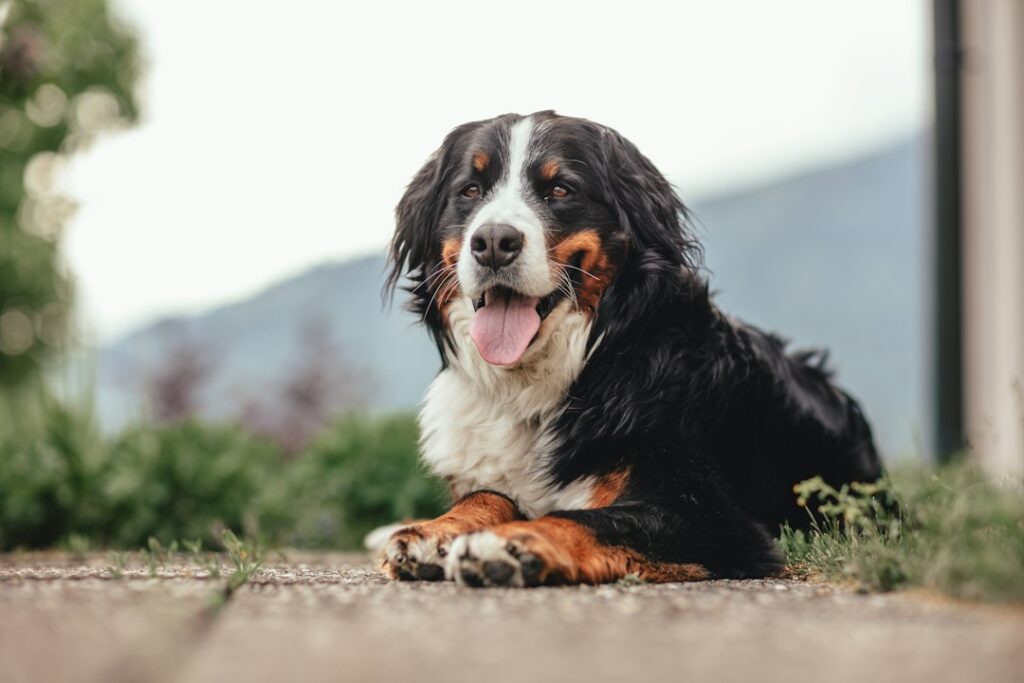
A Bernese Mountain Dog brings a large working-dog body, a substantial coat and a strong interest in family life into the home. The attractive tricolor appearance and gentle reputation can hide the practical work involved in raising and caring for a heavy adult. Space means more than a large garden: it includes transport, comfortable resting areas, safe handling and a plan for veterinary care if mobility changes. This guide helps you assess that everyday commitment, ask useful health questions and build a routine that suits the individual dog rather than relying on a charming puppy photograph.
Decide whether a Bernese Mountain Dog fits your home
This is a large Swiss working breed with a history of farm tasks, including draft work. Many individuals are affectionate with familiar people, but a breed description is not a guarantee of temperament. A playful adolescent can still jump, pull or knock over a small child without intending harm. Meet adult dogs where possible and ask how they behave in ordinary household situations, not only when settled after a show or training session.
A large adult needs space to turn, stretch and rest without blocking essential routes. Consider narrow stairs, slippery floors, high vehicle steps and the distance to a suitable toilet area. Think beyond the first year: how would you help a full-sized dog if it injured a leg? A ground-floor resting option, safe footing and realistic transport matter as much as the size of the lawn. If the home only works while the animal can leap into a car or climb several flights, plan alternatives before committing.
Look for health evidence rather than broad assurances
Ask for identifiable records for the parents, including recommended orthopedic, eye, cardiac and relevant DNA evaluations. The exact programme and interpretation should be checked with the breed club and your veterinarian. A seller saying the parents were vet checked does not establish that specific inherited-risk assessments were performed. Match names or identification details to the documents and ask what each result does and does not tell you.
A Bernese Mountain Dog can have a completed public testing record without every result being normal. The breed club emphasizes that reporting schemes and certificates should be read, not mistaken for blanket clearance. A favorable result also cannot guarantee a puppy will never develop disease. Ask about close relatives, longevity and the breeder’s willingness to discuss unfavorable information openly. An honest conversation about risk and follow-up is more useful than an advertisement promising a completely disease-free line or treating a single DNA panel as a complete health forecast.
For example, a DNA result for one inherited variant and a clinical eye examination answer different questions. One does not substitute for the other because both are described broadly as testing. Ask which dog was assessed, at what age, by whom and whether a repeat examination is recommended. Check that the report concerns a parent of the proposed litter rather than another dog with a similar name. If the information is unclear, pause the purchase discussion and ask for clarification rather than accepting an assurance that everything was done. A responsible source should be willing to explain the records and allow an independent veterinarian to review them. Keep copies for later care so the history remains useful after the puppy leaves its original home.
Take cancer history seriously without diagnosing by breed
Cancer is an important concern within the breed, and breed-club health efforts include research and sharing information about affected dogs. Ask what is known about close relatives and what records are available. A family history can support informed decisions, but it cannot predict with certainty what will happen to one puppy. Avoid assuming every lump is cancer or that a dog without an affected parent has no risk.
During ownership, report persistent or growing swellings, unexplained weight loss, altered appetite, declining stamina or a limp that does not resolve appropriately. These changes can have several causes, so assessment is needed rather than a diagnosis made from the breed name. Keep a dated note of what you noticed and arrange veterinary advice. Do not rely on a supplement marketed for cancer prevention to replace examination or evidence-based care. Discuss realistic financial preparation, insurance where available and the kind of medical support accessible to your household.
Feed growth without trying to produce the biggest puppy
Choose a complete diet appropriate for a growing large-breed dog and review portions with your veterinarian. The goal is controlled healthy growth and suitable body condition, not the highest possible weight at each monthly photograph. Keep a record of food, treats and changes in shape or movement. Do not add calcium, vitamins or growth powders simply because the bones look large; extra supplementation can disrupt an otherwise appropriate feeding plan.
A Bernese Mountain Dog puppy may look awkward during development, but visible discomfort or abnormal movement should not be dismissed as a harmless phase. Ask how to monitor ribs, waist and muscle rather than relying only on the scale. Our puppy feeding guide explains practical portion planning. If the puppy is consistently loose-stooled, reluctant to eat or gaining excessive fat, seek a review instead of repeatedly changing foods and adding extras. A stable measured plan is easier to assess than a collection of unrecorded supplements and snacks.
Build movement gradually and protect comfortable footing
Young large dogs benefit from suitable activity and learning, but repeated forced impact and ambitious endurance exercise are different from ordinary age-appropriate exploration. Ask your veterinarian about a plan that reflects development, condition and any orthopedic concerns. Avoid adopting a precise exercise formula from a social-media chart as though every puppy’s joints mature on the same day. Watch the individual animal’s response during and after activity.
Use surfaces that allow confident traction, and manage repeated jumping from vehicles or furniture. A comfortable ramp may help some households if introduced and used safely. A Bernese Mountain Dog that becomes reluctant to rise, changes gait or avoids a familiar step needs assessment rather than stronger encouragement. Our hip dysplasia guide provides background for orthopedic discussions. Do not give human pain medicine to make an animal complete its usual route. Adjust the task and get advice about the cause of discomfort.
Teach the skills that will matter at adult size
Reward calm greetings, attention, comfortable lead handling and settling before the puppy becomes difficult to manage physically. Practice short sessions in achievable environments and introduce distractions gradually. A small jump that seems endearing at first can become a problem when the same behavior involves a heavy adolescent. Give visitors clear instructions so the dog is not rewarded by one person for jumping and corrected by another for the same action.
The dog does not need harsh handling to learn boundaries. Our behavior and training guide explains humane approaches to everyday difficulties. Build useful exchanges for objects and teach comfortable movement through doorways rather than relying on strength. If pulling or arousal already exceeds the handler’s ability, obtain practical professional help and use a manageable environment. Equipment can support control, but it cannot replace teaching. Choose lessons that make daily life safer and more predictable, not a collection of tricks while essential handling remains unresolved.
Plan family contact and time alone realistically
Many dogs of this breed enjoy being close to their household. A large garden does not substitute for social contact, and leaving the animal outside as a decorative guardian does not meet the same needs as living comfortably with people. Provide predictable interaction, rest and appropriate activities. Teach children to let a resting dog sleep, avoid climbing on it and respect movement away from contact.
Practice comfortable short separations gradually rather than assuming an affectionate puppy will manage a long workday without preparation. Monitor the response and ask for help if the dog becomes distressed. Our separation anxiety guide describes why an individual plan may be needed. Arrange support for absences, including suitable caregivers and a realistic space for a large animal. Do not make another dog the automatic answer; adding a pet creates its own compatibility and care responsibilities. The goal is a daily routine the household can actually sustain.
Maintain the coat without relying on a summer shave
The substantial double coat requires regular attention to loose hair, tangles and skin. Work through manageable sections with suitable tools, checking areas behind the ears, under equipment and along longer furnishings. Ask a groomer to demonstrate a routine on the actual coat. Surface brushing can leave compacted material beneath, while excessively forceful work can irritate skin. Short comfortable sessions are more useful than occasional painful rescue grooming.
Bathing needs thorough rinsing and appropriate drying, particularly where dense hair retains moisture. A Bernese Mountain Dog should not automatically be shaved closely for warm weather or shedding. Discuss any medical or severe-matting exception individually rather than adopting an absolute cosmetic rule. If the skin becomes wet, sore, smelly or persistently itchy, arrange veterinary assessment. Our dog skin problems guide can help you organize observations, but a grooming product is not a diagnosis or a substitute for treatment.
Make warm-weather management part of daily planning
A heavy coat and large body mean you should take heat and humidity seriously. Choose cooler conditions for appropriate activity, provide water and comfortable shaded or indoor rest, and avoid hot enclosed spaces. Do not use the animal’s willingness to keep playing as the only safety signal. Excitement can continue even when conditions are unsuitable, and a recently shortened coat does not make dangerous heat exposure acceptable.
Plan transport with the same care. A parked vehicle is not a safe waiting area while someone shops or finishes an errand. Observe breathing, responsiveness and willingness to move, and seek urgent veterinary advice for suspected heat illness. Our heatstroke guide offers related emergency context. Prevention should be built into the schedule rather than improvised after the dog is distressed. If your home cannot offer a reliably comfortable environment during the local hot season, reconsider whether this breed’s needs can be met before choosing a puppy.
Know the signs of a possible bloat emergency
Gastric dilatation-volvulus is a life-threatening emergency that is more common in large deep-chested dogs. Repeated unproductive retching, restlessness, drooling, abdominal discomfort or swelling, weakness and collapse are concerning signs. The abdomen does not have to look dramatically enlarged for veterinary attention to be urgent. Do not wait to see whether a walk, food change or home remedy settles the dog.
Our dog bloat emergency guide explains why prompt care matters. Contact a veterinarian immediately and follow transport instructions if the condition is suspected. Discuss the individual dog’s risk and any preventive options, including whether gastropexy is appropriate, during routine appointments rather than during an emergency alone. No feeding arrangement eliminates every risk, so avoid absolute promises about a bowl type or meal schedule. The useful owner skill is recognizing a concerning change and reaching professional assessment without a delay caused by attempted household treatment.
Budget for a large dog’s ordinary and unexpected needs
Food quantity is only one part of the expense. Consider appropriately sized transport equipment, bedding, grooming support, training, parasite prevention and veterinary care. Services may vary in cost according to the animal’s size and medical needs. Arrange a plan for unexpected illness before it occurs rather than assuming routine puppy costs represent the entire commitment. Ask what local insurance or savings options are practical for your situation without relying on an advertised price from another country.
A Bernese Mountain Dog may also need help with access and handling as it ages. Think about how two adults could safely assist if advised, whether the vehicle can accommodate a large resting animal and which clinic can provide required care. Do not improvise lifting a painful heavy dog alone. Our arthritis home-care guide discusses comfort adaptations. Preparing sensible options early makes care more achievable when mobility changes, even though the exact future medical situation cannot be predicted.
Use adult meetings to test your expectations
Meet suitable adult dogs in ordinary settings and ask owners what takes time each week. Observe coat maintenance, indoor space use, greeting behavior and how the dog enters a vehicle. A calm adult in a familiar environment can teach you more about practical size than a litter of puppies can. Ask what adolescence was like and which skills mattered most, while recognizing that your individual dog may still differ.
Visit a rescue or responsible breed contact with a list of household realities: work hours, climate, stairs, existing pets, children’s ages and transport. Be open to an adult animal whose behavior and medical history are better understood. A Bernese Mountain Dog is not automatically easy because it has a friendly reputation, nor unsuitable simply because it is large. The decision depends on whether you can meet actual needs consistently. Transparent information, realistic planning and a willingness to seek help matter more than selecting the most symmetrical markings.
Questions before choosing a Berner
Is a Bernese Mountain Dog a low-maintenance family pet? It can be a rewarding companion, but adult size, coat work, training and health planning are substantial responsibilities. Family friendliness should never replace supervision or respectful handling around children.
Does a health certificate guarantee a healthy puppy? No. Read the actual results, confirm identification and ask about relatives. Screening reduces uncertainty in specific areas; it cannot forecast every disease or guarantee a particular lifespan.
Can it live comfortably in a warm climate? The household must provide reliable temperature management and appropriate activity. Do not rely on shaving, shade alone or the dog’s enthusiasm to make dangerous conditions safe. Consider whether you can provide comfort throughout the hottest periods.
What is the best preparation? Meet adults, review health evidence, plan large-dog transport and establish a workable daily care budget. Choose the animal for a life you can support, including adolescence and possible later mobility needs, rather than for a brief stage when it is small enough to carry everywhere.